
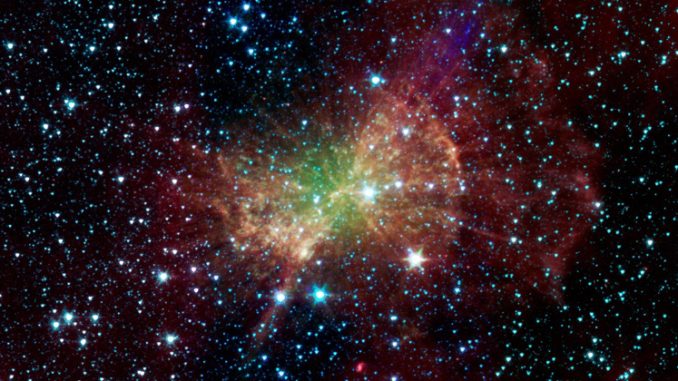
A busy trading planet on the outskirts of the galaxy. Small ships swoop around like space-starlings.
The red sun casts its terrible light into the cockpit of the trader’s cargo ship.
“Request docking,” said the trader, into a communication screen.
The screen showed only static.
“Request docking,” repeated the trader, a hint of nerves creeping into his voice.
After a full minute, an elderly alien lady’s face appears.
Dot Cotton, overlord of the trading planet
“Alight Pete, bring your ship in. Your usual pitch is ready,” she says, lighting a space-cigarette.
“Cheers Dot, love. See you in the Vic later for a holo-pint?”
“Alright.”
1985, and so begins Eastenders in Space, the most ambitious television programme the BBC ever undertook.
“We wanted to show identifiable, realistic working class characters just going about their daily lives in space,” said creator Julia Smith in a 1993 Wogan interview.
“You have to remember that this was an era of Dallas and Dynasty, these fantasy shows about fabulously wealthy people which were set very much on Planet Earth.”
At first Smith and her writing partner and Tony Holland looked to Coronation Street for inspiration.
“It had the working class feel we were looking for but it felt old-fashioned – there were no spaceships, aliens or laser battles.
“It was a nostalgic view of the working class, just going to the shops and smoking fags. There were no meteor showers or galactic overlords.
“Eastenders in Space would depict a realistic group of working class people in space, something that real working class people could relate to.”
Set around a busy space-market, Pete Beale ran a pitch that sold fruits and vegetables from across the galaxy. He would spend his lunchtimes in the Queen Viclaxion, a bar that served holo-pints and star pies.
Each week would see a laser-battle and a space ship race, just like in real life.
“It hit big,” remembered Smith.
“18 million viewers. Incredible for a debut like that.”
However, despite the popularity of Eastenders in Space with the public, the show wasn’t to last.
“Too expensive, they said,” said Smith with a bitter laugh.
“Of course it was expensive, it was a biweekly soap opera set in space.”
However, the BBC weren’t prepared to countenance the licence fee going up to the £22,000 per month it would have cost to keep Eastenders in Space on the air so Smith and Holland were forced to make changes.
“We took out the space aspect and set it in the east end of London. We cut the laser battles and made the stories more small-scale and human, and we took out all the aliens.”
Although, not quite all the aliens.
As Smith later revealed in her biography, in order to keep true to the original spirit of Eastenders in Space, Arthur Fowler was actually a Rgalian from the 9th Sector, and if you were to look closely, you would have seen that, even though he appeared human, he had the distinctive gills that mark out all Rgalians.
However, the storyline where son Mark Fowler finds out about his Rgalian heritage was never shown.
The Dumb Movie Database
CLICK HERE FOR THE DUMBEST MOVIE DATABASE ON THE WHOLE INTERNET
TV FILM GUIDE
CLICK HERE FOR OUR WEEKLY TV GUIDE
Be the first to comment